
|
A Marketing Synonym Game Introduction Consumers are attracted to new ideas. It can be trends, places, products or simply features. Usually new features aren't really new, they're nothing more than marketing hype. Every year we are exposed to new models of televisions and new models of cars, and more often than not, there is nothing really new or better inside. Digital audio "Upsampling" and "Upconversion" also falls into this reality. This kind marketing drive has subtly entered the world of digital audio and some companies have managed to increase the sales of their digital audio products by claiming the use of the "new" upsampling technology. The goal of this article is to explain the reality of these technical concepts, leaving all myth aside, and to provide a better understanding of what is really happening with this aspect of digital audio technology. Basic Digital Audio Theory
Let's start with the basic Pulse Coded Modulation (PCM) theory. PCM
is a method of converting an audio signal from its native analog format

into the digital domain where it is comprised of only zeros and ones.
This is done on a Compact Disc (CD) for example, and then the original
analog signal is recovered by playing the CD in a CD player. PCM works
as follows: The analog signal is defined by a value on two axis, amplitude
and time. At the sampling frequency, 44.1kHz for CD audio, the amplitude
of the signal is encoded into 16-bits words. This means that every
1/44,100th of a second, the closest numerical value to the amplitude
of the original analog signal is stored. Since 16-bit words are used,
there are 65,536 possible values (216). When the analog signal is
recreated using a digital filter followed by a digital-to-analog converter
(DAC), found inside every CD Player, all of these encoded numerical values
are restored to their original amplitudes with respect to the time axis,
recreating a signal with a staircase shape; each step's limit corresponds
to the finite value in time and amplitude of the encoded digital signal.
This signal is then sent to a reconstruction filter that "smoothes" out
the staircase shaped signal, creating an output signal without all the
jagged steps. This result is an analog signal, which should closely
resemble that of the original analog signal.
Oversampling The oversampling technique was developed to get away from a "brickwall filter". A digital system interpolates new points between the different original samples to obtain an artificially higher sampling rate. This allows the use of a less aggressive filter because it doesn't have to eliminate frequencies as close to the frequencies it must not affect. It first began as four times (4x) oversampling (i.e. 176.4kHz), then later eight times (8x) oversampling (i.e. 352.8kHz). The digital filter must perform many mathematical calculations to determine the value of the point it must add to the original digital signal. Often, this calculated value may fall between two discrete values, so the oversampling system must round off the value to the closest discrete value. To increase the precision of the resulting calculated value, DACs and digital filters with more than 16-bits of resolution were therefore introduced. We have seen 18-bit, 20-bit and 24-bit digital filters and DACs. It is important to note that oversampling creates an artificially higher sampling frequency, which does not extend the real frequency response of the original media or the system, but simply extends the frequencies that need to be filtered out, allowing for a simpler and better sounding analog filter. Upsampling & Upconversion
One of the latest storage mediums is the popular the Digital Versatile
Disc (DVD). When developing this new standard, a higher-than-CD
resolution PCM format was adopted with a maximum resolution of
24-bits/96kHz. For the professional market, this new format had
to be compatible with the CD's 16-bit/44.1kHz resolution. This
would allow the conversion of original recordings to the new
standard. So a sample-rate converter chip, which is nothing more
than an oversampling digital filter, was created to actually
convert any digital signal from one standard format to another
format. For example, a 16-bit/32kHz signal can then be converted
to 24-bit/96kHz and 24-bit/96kHz can also be converted to 16-bit/48kHz.
This gave rise to the marketing hype with the concepts of upsampling
and upconversion, which claims could upsample or upconvert your
16-bit/44.1kHz CD to a 24-bit/96kHz resolution digital signal
prior to the digital to analog conversion, resulting in DVD-audio
like quality from CD. While this statement is a great idea for
marketing purposes and is surely impressive to most consumers,
it is technically only half true, and is not the best way to
improve the audio quality that can be derived from CDs.
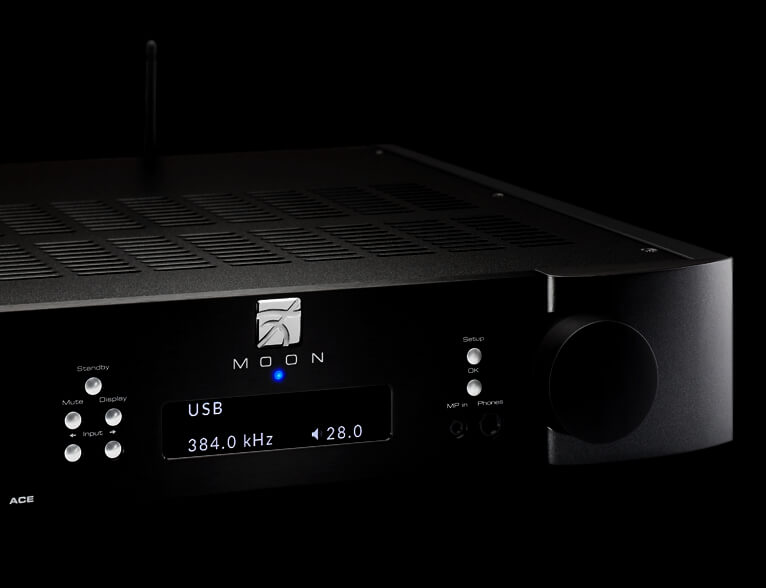
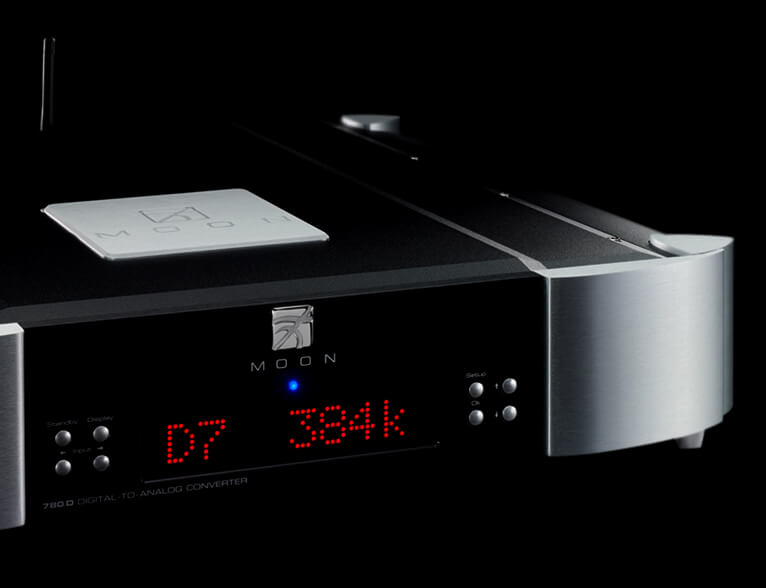
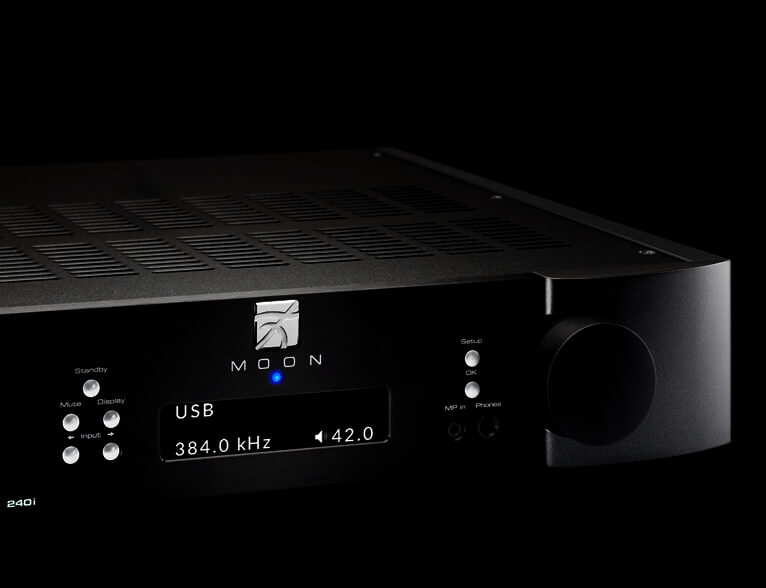
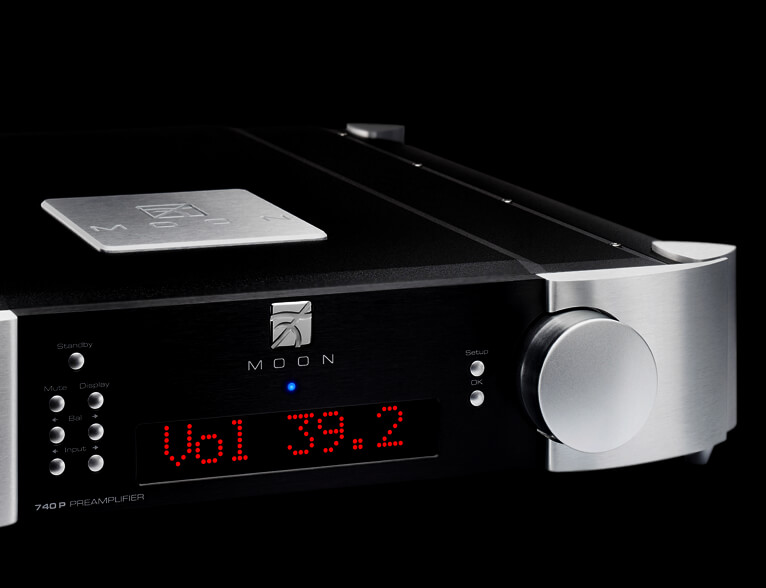
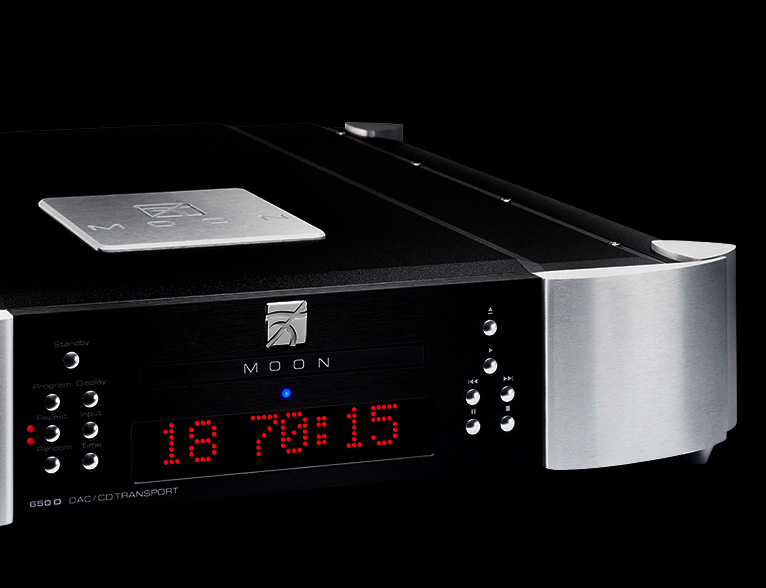
Simaudio MOON CD Players
Often we're asked why we don't include some type of upsampler in our MOON CD players.
The answer is simple: All of these CD Players use a digital filter that performs
eight times (8x) oversampling with a digital output signal at 24-bits of resolution.
In numerical terms this represents 24-bit/352.8kHz digital signal resolution, which is
significantly higher than that of either a 24-bit/96kHz or 24-bit/192kHz
upsampler. What would be the point of using a lower resolution technique?
Furthermore, the 352.8kHz digital signal does not suffer from any error and
mathematical truncation resulting from the use of a non-integer multiple sample
rate conversion frequencies like 96kHz and 192kHz. Using this same reasoning and
pushing the envelope even further, the MOON Andromeda employs a digital
filter that performs sixteen times (16x) oversampling yielding an astounding 24-bit/705.6kHz
level of resolution.
|
||||||||||||||||||||||||||||||||||||
|
 
|
|