
PRODUCTS
  New Products
  MOON Evolution Series
  MOON Series
 
      300D DAC
      100D DAC
 
      360D Disc Player
      260D Disc Player
      230D Disc Player
 
      340i Integrated Amp
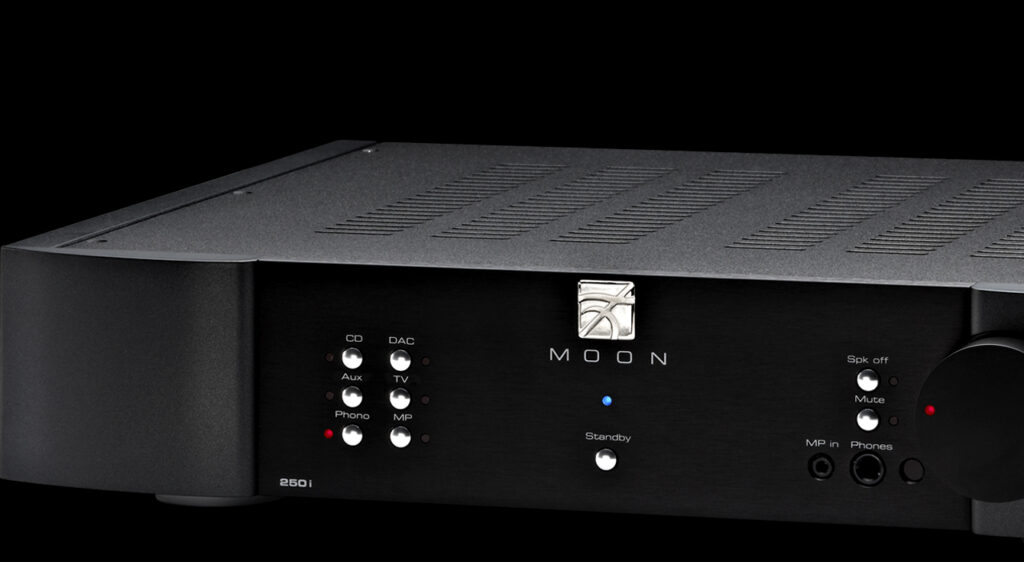
      250i Integrated Amp
      220i Integrated Amp
 
      310LP Phono Preamp
      320S Power Supply
      110LP Phono Preamp
 
      350P Preamplifier
      400M Amplifier
      330A Amplifier
 
      Titan Amplifier
 
  Older Products
 
INFORMATION
  Simaudio News
  Press Releases
  Product Awards
  Product Reviews
  Education
  Literature
  Recommended Music

 
COMPANY
  Background
  Green Practices
  Factory Tour
  Photo Gallery
  Unauthorized Sales
  Career Opportunities
  Contact Us

 
SUPPORT
  Where To Buy
  Product Registration
  Warranties
  Owner's Manuals
  F A Q
  Factory Upgrades
  Service
 
MOON SERIES
100D Digital-to-Analog Converter
Updated: August 29, 2011    


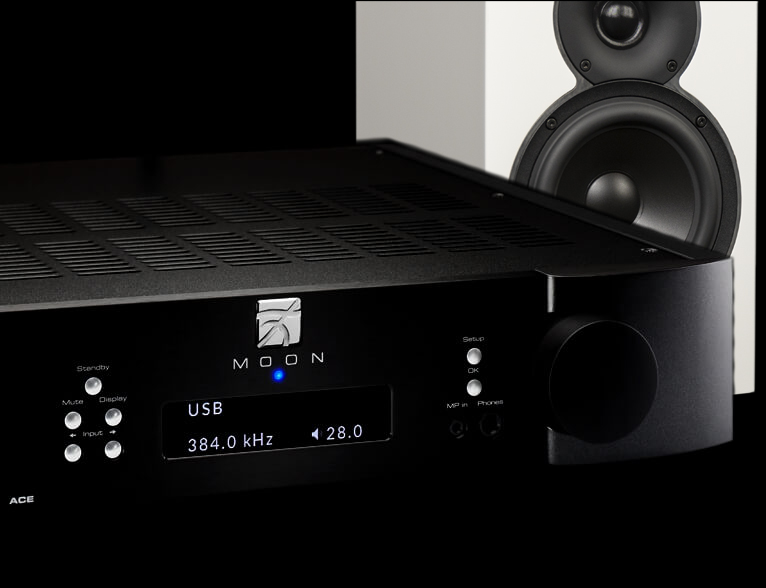
The MOON 100D Digital-to-Analog Converter accepts USB, S/PDIF and TosLink inputs. Intended for use with a computer via the USB input, the remaining inputs allow for interfacing with other source components such as a music server, digital transport, etc. All digital input signals are processed through an asynchronous sample rate converter and then 24-bit DACs.
 
The 100D is housed in a compact chassis constructed of rigid aluminium and features a 1/4” brushed and anodized faceplate. Don't be deceived by its small footprint since trickle-down technology dominates, thanks in no small part to its larger sibling, the 300 D ... Amazing things do come in small packages.
 
 
Musical ...     Stylish ...     Compact ...

 
Using 24-bit/1.411MHz processing, the MOON 100D will faithfully reproduce your digital music in an effortless fashion. Accepting an input signal from 44.1 to 192kHz with a bit-depth range from 16 to 24-bits, jitter is a virtual non-issue thanks to the asynchronous operation of this DAC. Sonically, it portrays all of the Simaudio hallmarks: clean, powerful, fast, extended bass combined with an open midrange and airy extended high frequencies.


  Significant Design Features:
 
· Power supply with 3 stages of DC voltage regulation
· A fully asynchronous sample rate converter
· BurrBrown PCM1793 high-resolution 24-bit/192-kHz D/A and 8X oversampling digital filter
· Accurate digital clocking system for exceptionally low intrinsic jitter levels
· Single-ended RCA analog outputs
· Advanced analog signal path using a DC servo circuit and proprietary analog filter
· Pure copper circuit board tracings with extremely low impedance characteristics
· Extremely rigid chassis construction to minimize the effects of external vibrations
· Accurate matching of high quality components in a symmetrical circuit design

· Designed to be powered up at all times for optimal performance.


To view a larger image of the 100D DAC's internal circuitry, simply point-and-click your mouse over the image located to the left.


To view a larger image of the 100D DAC's rear panel, simply point-and-click your mouse over the image located to the right.


An important note about the USB input
 
The USB input on the MOON 100D accepts a digital audio signal of up to 16-bits/48kHz. This is the native specification of the USB input. However, if you require a higher sampling rate, there are ways to achieve this with the 100D.
 
Rather than including a USB input for sampling rates exceeeding 48kHz, we opted to provide the best possible power supply, D/A converter and analog stage in the MOON 100D at this price level. Also, keep in mind that USB wasn’t originally intended for use with hi-resolution audio; there are latency issues which compromise sound quality (i.e. jitter and phase errors, etc.). These could be minimized through dedicated costly circuitry, but this would significantly drive up the cost of the 100D without improving the sonic performance on any of the other inputs.
 
If you intend to use the MOON 100D’s USB input, it’s very likely that your computer is a data source for music. Today most computers with a built-in sound card will have either an S/PDIF (RCA connector) or Toslink (optical connector) digital audio output, thus eliminating the need for a USB input on the 100D. Furthermore, if you’re committed to getting the most out of the music stored on your computer, then in all likelihood you have installed an after-market soundcard in your computer. Virtually all of these soundcards have at least one S/PDIF, Optical or AES/EBU (XLR connector) digital output. At this point, USB connectivity becomes irrelevant. The USB input is there for convenience as opposed to performance.
 
In the event that you wish to use your computer’s USB connection with files greater than 48kHz, there are several relatively inexpensive after-market products; compact one-box USB-to-S/PDIF interfaces that will work with USB datastreams up to 24-bit, all the way up to 192kHz.