
|
|
|
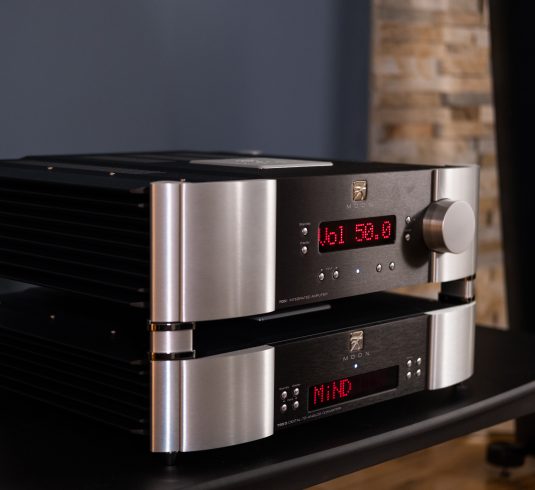
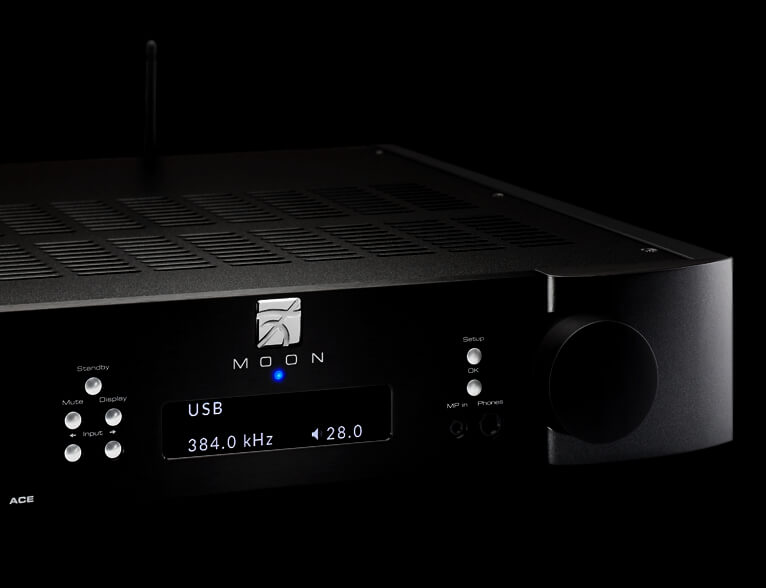
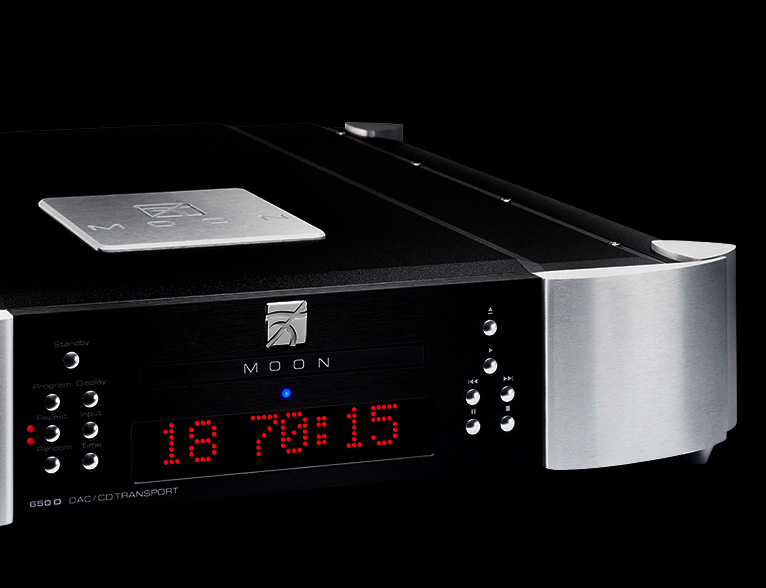
MOON EVOLUTION SERIES 650D DAC / CD Transport
|
Updated: November 1, 2011
|
| |
Revolutionary Technology ...
Another MOON 32-bit asynchronous DAC
The MOON 650D Digital-to-Analog Converter / CD Transport follows in the footsteps of the highly acclaimed
MOON 750D. Applying what is commonly referred to as trickle-down technology, we have created a product that yields almost all of the 750D’s performance, but
at a more accessible price-point. True 32-bit fully asynchronous digital audio playback
is achieved by the 650D using a fully balanced differential dual-mono design featuring our own
M-AJiC32 circuitry (an asynchronous jitter elimination system). Built around
the ESS SABRE32 Ultra DAC operating in 32-bit Hyperstream™, the conversion process uses an astonishing 8 DAC’s per channel. The final result is a product
that will breakdown all the barriers, bringing you closer to the music than ever before, regardless of how your digital media is stored, be it on a CD,
computer, music server, etc.
The back panel features a complete array of digital input (4) and output (2) connections to meet all the needs of today’s ever-widening technologies. The front
panel includes a disc drawer for our own proprietary drive mechanism which represents a fifth input. As well, in the coming months, an optional outboard power
supply will be made available to further enhance the already astonishing performance of the MOON 650D.
Cutting edge technology that creates lifelike and realistic music.
Of course, all of the signature features you’d expect in a MOON Evolution series digital product are present: our revolutionary M-Quattro floating suspension,
SimLink, i²DCf, just to name a few, as well as both RS-232 and IR ports for custom-install environments. Finally, a plethora of user selectable cosmetic
options are available at the time of purchase.
Effective November 2011, the asynchronous USB input will be capable of 24-bit/192kHz performance. An upgrade is available for units built before this date.
|
|
| |
Significant Design Features:
· True 32-bit asynchronous Digital-to-Analog converter
· ESS Technology SABRE32 Ultra DAC / Digital Filter (ES9016) working in 32-bit Hyperstream™
to achieve unprecedented jitter immunity and low-level linearity via a patented Time Domain
Jitter Eliminator
· Digital Audio Signal Processing with M-AJiC32 (MOON Asynchronous Jitter Control in 32-bit mode)
· Four (4) digital inputs (AES/EBU, S/PDIF, TosLink and USB) allowing for a connection to virtually any digital source
· Proprietary CD drive system mounted on our M-Quattro gel-based 4-point floating suspension for
vibration damping, allowing ambient & spatial cues in your recordings to come to life like never
before - The fifth digital input
· A virtually jitter-free - 1 picosecond - digital clocking system
· RS-232 port for (i) full unsolicited bidirectional feedback and (ii) firmware updates
· IR input for external control
· Two (2) digital outputs – AES/EBU and S/PDIF
· Fully balanced differential digital and analog circuitry in a dual-mono design
· Separate digital & analog power supplies using 2 independent toroidal transformers
· SimLink controller port for 2-way communications with other compatible MOON components
· Power supply voltage regulation includes i²DCf (Independant Inductive DC Filtering); There is
one inductor dedicated to each integrated circuit type component (DAC, Op-Amp, etc.) in the
audio circuit’s signal path - 18 stages in all
· A very short capacitor-free signal path using a DC servo circuit and proprietary
12dB/octave analog filter
· 4-Layer PCB’s with pure copper tracings for a much shorter signal path; This results in
greater sonic accuracy and a dramatically improved signal-to-noise ratio
· Ultra rigid chassis construction to minimize the effects of external vibrations
· Accurate matching of the very finest quality electronic components in a symmetrical circuit design

· Designed to be powered up at all times for optimal performance
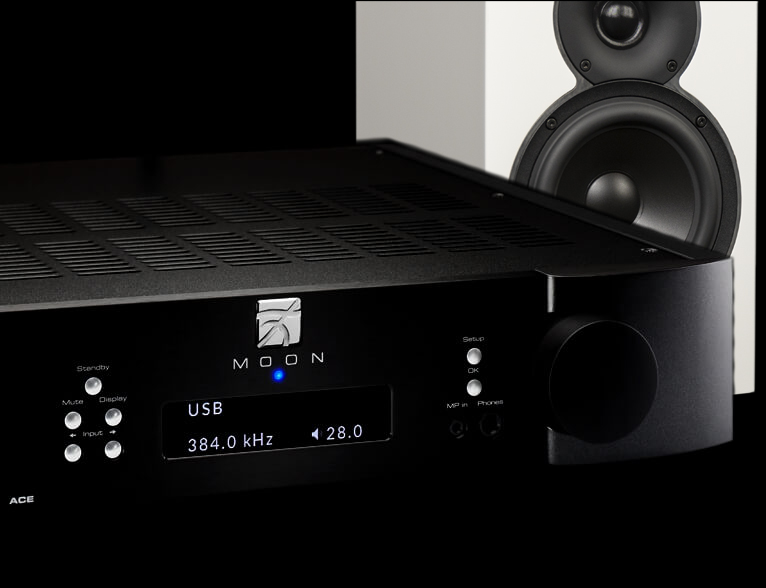
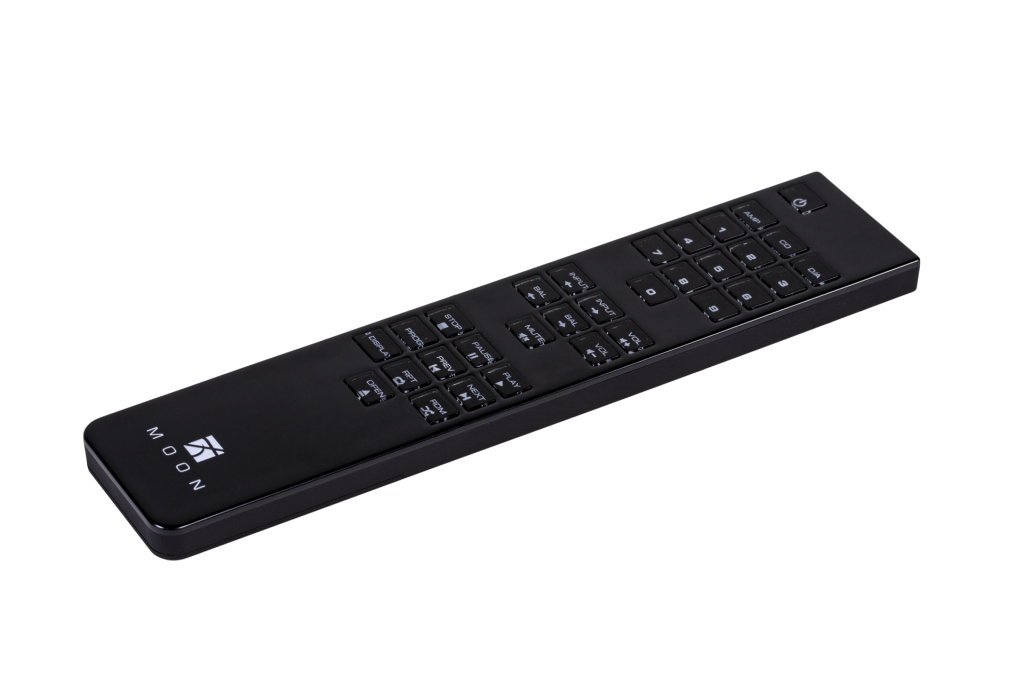
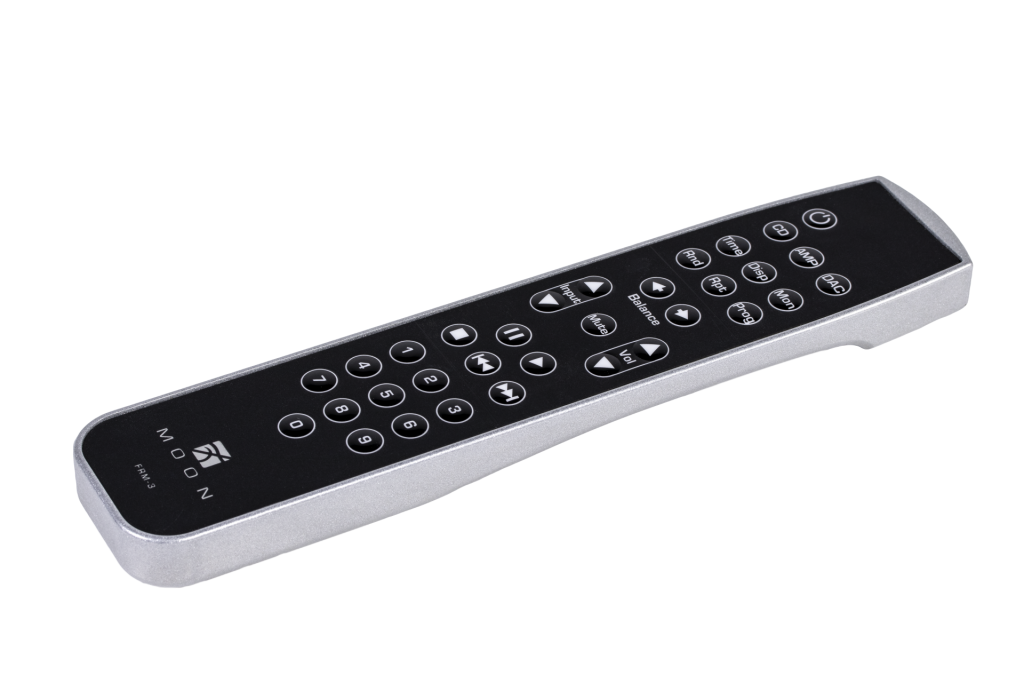
· Includes FRM-2 remote control.
|
|
| |
|
|
To view a larger image of the 650D's internal circuitry, simply point-and-click your mouse over the image located to the left.
|
|
| |
To view a larger image of the 650D's rear panel, simply point-and-click your mouse over the image located to the right.
|
|
|
|
| |
An important note about the USB input - applicable to units built before November 2011
The USB input on the MOON 650D accepts a digital audio signal of up to 16-bits/48kHz. This is the native specification
of the USB input. However, if you require a higher sampling rate, there are ways to achieve this with the 650D.
Rather than including a USB input for sampling rates exceeeding 48kHz, we opted to provide the best possible power supply, D/A converter and analog stage in the
MOON 650D at this price level. Also, keep in mind that USB wasn’t originally intended for use with hi-resolution audio;
there are latency issues which compromise sound quality (i.e. jitter and phase errors, etc.). These could be minimized through dedicated costly circuitry, but this
would significantly drive up the cost of the 650D without improving the sonic performance on any of the other inputs.
If you intend to use the MOON 650D’s USB input, it’s very likely that your computer is a data source for music.
Today most computers with a built-in sound card will have either an S/PDIF (RCA connector) or Toslink (optical connector) digital audio output, thus eliminating
the need for a USB input on the 650D. Furthermore, if you’re committed to getting the most out of the music stored
on your computer, then in all likelihood you have installed an after-market soundcard in your computer. Virtually all of these soundcards have at least one S/PDIF,
Optical or AES/EBU (XLR connector) digital output. At this point, USB connectivity becomes irrelevant. The USB input is there for convenience as opposed to performance.
In the event that you wish to use your computer’s USB connection with files greater than 48kHz, there are several relatively inexpensive after-market products;
compact one-box USB-to-S/PDIF interfaces that will work with USB datastreams up to 24-bit, all the way up to 192kHz.
| |
|